Learning something new is easy, but remembering it for a long time can be difficult. Many students spend hours reading books, watching lectures, and highlighting important lines, but still forget most of the information after a few days. This happens because reading something again and again does not always mean that the brain has truly learned it.
One simple study method that can help is active recall. Active recall is a learning technique where you try to remember information without looking at your notes or the answer. Instead of simply reading information, you ask yourself questions and try to bring the answer from your memory.
This simple method can make studying more effective and help you remember what you learn for a longer time. In this article, we will explain what active recall is, how it works, how to use it, and why it can be useful for students.
What Is Active Recall?
Active recall is a study technique that requires you to actively retrieve information from your memory. Instead of looking at your textbook and reading the same chapter several times, you close the book and try to explain what you remember.
For example, imagine you are studying the human digestive system. After reading about it, you can close your book and ask yourself, “What are the main organs involved in digestion?” Then you try to answer the question from memory.
If you remember the answer, your brain has successfully retrieved the information. If you cannot remember it, you can check your notes and try again.
This is what makes active recall different from passive studying. You are not just looking at information. You are making your brain work to find it.
Why Active Recall Works
The human brain becomes stronger at remembering information when we practice retrieving it. When you force yourself to remember an idea, fact, definition, or concept, you give your brain an opportunity to strengthen that memory.
Reading the same page five times can make the information look familiar. However, familiarity is not always the same as remembering. You may feel like you know the topic because you have seen the words many times, but when someone asks you a question about it, you may struggle to answer.
Active recall removes this problem because it tests whether you can actually remember the information.
This is one reason active recall is considered one of the most useful study techniques for students. It changes studying from simply receiving information into actively using your memory.
Active Recall vs Passive Studying
Passive studying means looking at information without testing yourself. Common examples include reading notes repeatedly, watching the same lecture again, highlighting large sections of a textbook, or copying information without trying to understand it.
These activities are not always useless, but they may not be enough when your goal is long term memory.
Active recall is different because you have to produce the information yourself.
For example, passive studying may involve reading a definition several times. Active recall would involve covering the definition and asking yourself what it means.
Passive studying can make you feel comfortable because the information is directly in front of you. Active recall can feel harder because your brain has to search for the answer. However, that difficulty can make the learning process more useful.
How to Use Active Recall While Studying
You do not need special equipment to start using active recall. A textbook, notebook, flashcards, or even a blank piece of paper can be enough.
Start by studying a small section of your topic. Read it carefully and make sure you understand the basic idea. Then close your book or put your notes away.
Now ask yourself questions about what you just studied.
Try to answer each question without checking your notes. Write the answer down or explain it out loud. After answering, check your notes to see what you got right and what you missed.
This process is simple, but it can make a big difference.
The most important part is to avoid looking at the answer too quickly. Give your brain some time to search for the information.
Use Questions Instead of Just Reading Notes
One of the easiest ways to practice active recall is to turn your notes into questions.
Suppose your notes say that water makes up a large percentage of the human body. Instead of reading that sentence repeatedly, turn it into a question such as, “Why is water important for the human body?”
If you are studying history, you can ask questions such as, “What caused this event?” or “What happened after this event?”
For science, you can ask, “How does this process work?”
For mathematics, you can solve problems without looking at the example.
For language learning, you can cover the meaning of a word and try to remember it.
Questions make your study sessions more active and help you identify the information you truly understand.
Use Flashcards for Active Recall
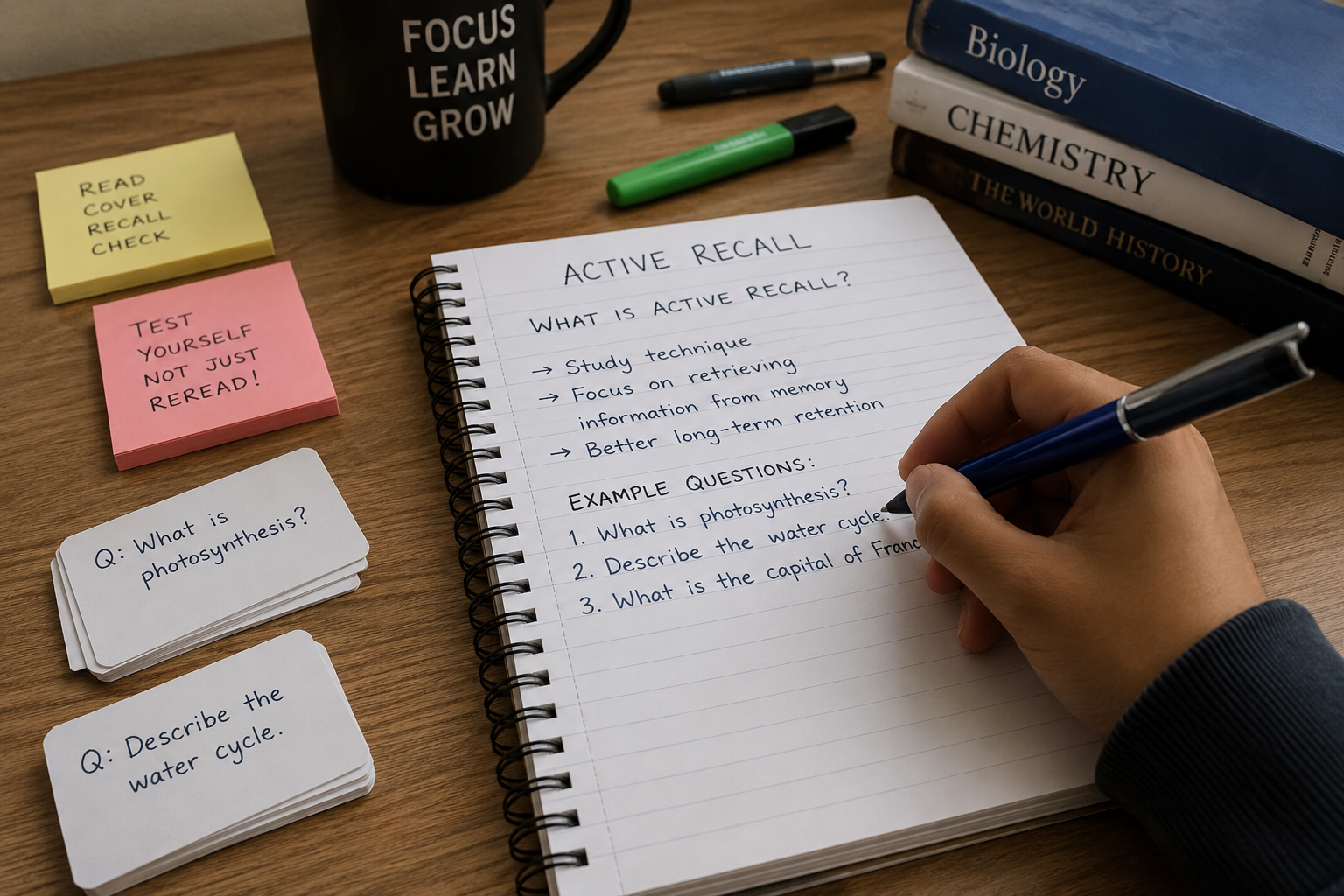
Flashcards are another popular way to practice active recall. One side of the card contains a question, while the other side contains the answer.
For example, the front of a flashcard might say, “What is photosynthesis?” You then try to answer the question before looking at the other side.
You can make physical flashcards using paper or use a digital flashcard application.
The important thing is not the tool you use. The important thing is that you try to remember the answer before checking it.
Flashcards are especially useful for vocabulary, definitions, formulas, dates, names, and important facts.
Write Everything You Remember
Another simple active recall method is the blank page technique.
Take a blank piece of paper and write the name of the topic at the top. Then write everything you can remember about that topic without looking at your notes.
Do not worry about making the answer perfect. The goal is to find out what is already in your memory.
After finishing, compare your answer with your textbook or notes. Look for missing information or mistakes.
For example, if you are studying the causes of climate change, write down all the causes you remember. Then check your notes and see whether you missed important points.
This method can quickly show you where you need more practice.
Explain the Topic in Your Own Words
Explaining a topic without looking at your notes is another excellent form of active recall.
Pretend that you are teaching the topic to a friend who knows nothing about it. Explain the idea using simple words.
If you can explain something clearly, it usually means you understand it well. If you get stuck or cannot explain a part of the topic, that section may need more study.
You can explain the topic out loud, write an explanation, or even pretend that you are giving a short classroom lesson.
The goal is to recall the information and organize it in your own mind.
Combine Active Recall With Spaced Repetition
Active recall becomes even more useful when combined with spaced repetition.
Spaced repetition means reviewing information at different times instead of trying to learn everything in one long study session.
For example, you might study a topic today, test yourself tomorrow, review it again after several days, and then test yourself again the following week.
Each time you retrieve the information, you give your memory another opportunity to strengthen.
This approach can be much better than studying everything the night before an exam.
You should focus more attention on information that you frequently forget. Information that you already know well can be reviewed less often.
Common Mistakes When Using Active Recall
Although active recall is simple, students sometimes use it incorrectly.
One common mistake is checking the answer too quickly. If you look at your notes immediately after asking a question, you are not giving your brain enough time to retrieve the information.
Another mistake is creating questions that are too easy. Good active recall questions should require you to think.
Some students also try to memorize everything at once. It is usually better to study smaller sections and test yourself regularly.
Another mistake is focusing only on facts. Active recall can also be used for concepts, processes, examples, and problem solving.
How Long Should You Practice Active Recall?
There is no perfect amount of time for active recall. What matters more is the quality of your practice.
You can include active recall in short study sessions. For example, after studying for thirty minutes, spend five to ten minutes testing yourself.
You can also use active recall during a longer study session. Study a chapter, close your book, and spend some time answering questions about what you learned.
Short and regular practice is often easier to maintain than long and stressful study sessions.
Benefits of Active Recall
Active recall offers several benefits for students.
First, it can improve long term memory because you repeatedly practice retrieving information.
Second, it helps you identify weak areas. When you cannot answer a question, you know that the topic needs more attention.
Third, active recall can make study time more efficient. Instead of spending hours rereading the same material, you spend more time actively using your memory.
It can also improve confidence before exams. When you regularly test yourself, you get a better idea of what you actually know.
Most importantly, active recall can help you become a more independent learner. You learn to check your own understanding instead of depending only on your notes or textbook.
Active Recall for Exam Preparation
Active recall can be especially useful when preparing for exams.
Instead of reading every chapter again from beginning to end, create questions based on the important topics. Then answer those questions without looking at your notes.
Practice previous exam questions if they are available. Try solving problems without checking the solution first.
You can also make a list of important topics and test yourself on each one.
If you cannot answer something, return to your notes, study the topic again, and test yourself later.
This creates a simple cycle of learning, testing, correcting, and testing again.
Final Thoughts
Active recall is a simple but powerful study method that can help you remember what you learn. It does not require expensive tools or complicated study plans. All you need is the willingness to close your notes and challenge your memory.
Instead of asking yourself, “How many times have I read this?” ask yourself, “Can I explain this without looking?”
That small change can completely improve the way you study.
You can use active recall with textbooks, notes, flashcards, practice questions, blank pages, and verbal explanations. When you combine it with spaced repetition and regular study sessions, it becomes an effective way to build long term memory.
The next time you sit down to study, do not spend the entire session simply reading. Read a section, close your book, and try to remember what you learned. You may find that active recall makes studying easier, more focused, and much more effective.